EnglishFrenchGermanSpainItalianDutchRussianPortugueseJapaneseKoreanArabicChinese Simplified
If you like the site do not forget to Subscribe to our mailing list

Enter your E-mail address:

Monday, April 8, 2013

Tiny rods and paddle make new thermal sensor

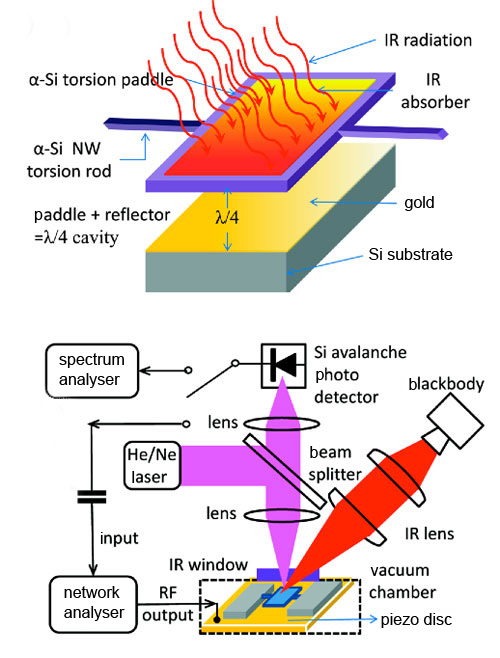
The micro-paddle and nanorod thermal sensor device.

Detecting infrared radiation with precision is a long-standing engineering challenge, and researchers are constantly pushing for sensors that are smaller, cheaper, and more sensitive. A new design combining micron-scale paddles with nanometer-scale support rods looks like a promising step forward — and the basic concept is elegantly simple.

The device works by suspending a tiny flat paddle using ultra-thin nanorods. When infrared radiation hits the paddle, it absorbs heat. That heat has to dissipate through the nanorods, and because nanorods are extremely poor thermal conductors, the temperature of the paddle rises noticeably even from a tiny energy input. The temperature change can then be read out as an electrical signal, giving a direct measure of the incoming infrared radiation.

Why the Geometry Matters

The combination of a large absorbing area (the paddle) with a very narrow thermal link (the nanorods) is the key to making this work. Maximizing the ratio of absorbing area to thermal conductance is essentially the recipe for a sensitive bolometer-style detector. The nanorod support structure achieves this ratio in a compact, chip-compatible design — something that's appealing for integration into portable devices or imaging arrays.

The researchers tested the device and found it was sensitive enough to function as an infrared imager. That means it could, in principle, be used to take thermal images — detecting heat signatures from objects without any external illumination. This kind of passive thermal imaging has applications ranging from security and surveillance to medical diagnostics and industrial inspection.

Where This Could Go

Current high-end infrared detectors often require cooling to work effectively, which makes them bulky and expensive. A sensor design that works at room temperature, can be miniaturized, and is built from straightforward microfabrication processes could be a game-changer for making infrared imaging more widely accessible. The nanorod-paddle geometry offers a path toward that goal, though bringing it from a proof-of-concept to a mass-produced imaging chip will take further engineering work.

Still, the results demonstrate that thoughtful structural design at the micro and nano scale can yield sensors with performance that rivals or exceeds more complex approaches. It's a reminder that sometimes the most effective solutions come from rethinking the basics of how heat and geometry interact.


Source: Physics World

Friday, April 5, 2013

Why water prefers the single life!?

Does liquid water have a double life? New research says probably not.

Water is one of the most studied substances on Earth, yet it continues to surprise. One of the more controversial ideas in physical chemistry is that liquid water might exist in two structurally distinct forms — sometimes called the "two-liquid" model. Under this theory, as water is cooled toward its freezing point, it could transition between a high-density and a low-density liquid state. If true, this would explain several of water's well-known anomalous properties, like the fact that it expands when it freezes.

But a major new study has thrown cold water on the idea. Researchers conducted an extensive computational search for evidence of this two-liquid behavior, and found none. Their work suggests that liquid water is much more consistent and uniform in structure than the two-liquid model predicts — preferring, it seems, to stay as a single, well-behaved phase rather than splitting into two distinct forms.

The Origins of the Controversy

The two-liquid hypothesis gained traction because water really does behave oddly near its freezing point. Its heat capacity, compressibility, and viscosity all show unusual peaks and troughs that other simple liquids don't. Proponents of the two-liquid model argued these anomalies were signatures of a hidden phase transition deep in the supercooled regime — a region below 0°C where water can remain liquid if cooled carefully.

The problem is that experimentally accessing deeply supercooled water is extremely difficult. The liquid tends to freeze suddenly before you can measure it properly. So the debate has been fueled partly by the inability to directly probe the critical region where the hypothetical transition would occur.

What the New Research Shows

Using detailed computer simulations of water's molecular behavior, the team found no evidence of a second liquid phase appearing as the temperature dropped. The properties of simulated water changed smoothly and continuously — no sudden shift, no hidden critical point, no two-liquid scenario. The researchers argue this makes the single-liquid model by far the more likely description of what's actually happening.

This doesn't mean water is boring. Its hydrogen-bonding network is still remarkably complex and gives rise to all the properties that make it so essential to life. But the idea that it secretly lives a double life as two different liquids looks increasingly unlikely — at least according to this work.


Source: Physics World

Graphene loudspeaker could rival commercial speakers and earphones!!!

Schematic of the graphene-based loudspeaker

Schematic showing a graphene diaphragm suspended between two perforated electrodes to create sound. (Courtesy: A. Zettl)

Graphene — the one-atom-thick sheet of carbon that has been called a wonder material — is now making its way into your earphones. Researchers at the University of California, Berkeley have built a graphene loudspeaker that can compete with, and in some cases outperform, commercial speakers and earphones. And it does it while using a fraction of the power.

How a Speaker Works (and Why Graphene Is Perfect for It)

All speakers work the same basic way: an electric signal causes a thin diaphragm to vibrate, creating pressure waves in the air — which we hear as sound. The key to a good speaker is having a flat frequency response, meaning it reproduces all sounds from the lowest bass (20 Hz) to the highest treble (20 kHz) with equal accuracy.

Conventional speakers struggle with this because their membranes are too heavy, requiring added "damping" systems to smooth out the sound. Graphene's ultralow mass solves this problem naturally. Team leader Alex Zettl explains that the graphene diaphragm is simply damped by the surrounding air itself — no artificial damping needed.

Built From a 30 nm Sheet

The Berkeley team grew graphene by chemical vapour deposition (CVD) into a sheet just 30 nanometers thick and 7 millimeters wide. They sandwiched it between two perforated silicon electrodes coated with silicon dioxide (to prevent short circuits). When alternating voltage is applied to the electrodes, the graphene sheet vibrates electrostatically, producing high-fidelity sound across the full human hearing range.

Why It Could Beat Your Current Earphones

  • Better frequency response: More consistent sound across all pitches than many commercial earphones.
  • Ultra-low power: Runs at just a few nano-amps — far less than conventional speakers, which is great for battery-powered devices.
  • Thin and flexible: Could be built into paper-thin surfaces, clothing, or curved devices.

We're still in the early stages, but the proof-of-concept is remarkable. The future of audio may literally be one atom thick.


Source: Physics World

Friday, March 1, 2013

Nanotube transistors detect cancer biomarkers!!

Engineered antibodies (green/red) bound to carbon-nanotube transistors that detect osteopontin, a prostate cancer biomarker. (Courtesy: University of Pennsylvania)

What if detecting cancer could be as quick and straightforward as a routine blood test? Researchers at the University of Pennsylvania have taken a meaningful step in that direction, showing that carbon-nanotube transistors can sniff out disease biomarkers at incredibly tiny concentrations — far beyond what conventional lab methods can achieve.

The team focused on a protein called osteopontin (OPN), which is a known marker for prostate cancer and several other malignancies. By chemically bonding engineered antibody fragments directly onto carbon nanotube field-effect transistors (NT-FETs), they created biosensors that respond electrically whenever OPN binds to the antibody. In other words, the cancer biomarker essentially announces its own presence by changing how electricity flows through the nanotube device.

A Thousand Times More Sensitive

The numbers here are striking. The nanotube sensors managed to detect OPN at concentrations as low as 1 picogram per milliliter — roughly 1,000 times more sensitive than the standard ELISA immunoassay tests currently used in clinical settings. And while ELISA tests can take days to return results, these nanotube sensors deliver readings in just minutes.

Mitchell Lerner, one of the researchers on the project, put it plainly: their sensors are simpler, faster, and vastly more sensitive than existing clinical tools. That kind of leap in performance matters enormously when early detection is so critical to cancer outcomes.

How the Technology Works

The antibody fragments used are genetically engineered single-chain variable fragments (scFv) — compact, highly specific molecules that latch onto OPN with great affinity. The team attached these to the nanotube transistors using a process called diazonium salt functionalization, which creates a stable covalent bond without destroying the antibody's binding ability.

When OPN molecules in a sample bind to these antibodies, they alter the electrical properties of the nanotube — specifically, they change the current flowing through the transistor. That change becomes the detection signal. The sensors also showed strong selectivity, meaning they responded to OPN without being thrown off by other proteins in the background.

Why It Matters Beyond Prostate Cancer

Osteopontin is elevated in several types of cancer, not just prostate cancer, which means this detection approach could potentially be adapted to screen for a range of malignancies. The team also noted that the functionalization method they developed should work for any antibody with an accessible amine group — making this a platform technology, not just a one-off solution.

We're still some distance from seeing nanotube transistors in clinical labs, but the proof-of-concept is compelling. Faster, cheaper, and far more sensitive cancer detection tools could one day make early diagnosis accessible to far more patients — and that's an outcome worth working toward.


Source: Physics World