EnglishFrenchGermanSpainItalianDutchRussianPortugueseJapaneseKoreanArabicChinese Simplified
If you like the site do not forget to Subscribe to our mailing list

Enter your E-mail address:

Sunday, January 18, 2015

Fast-moving glaciers slide more easily

Here's something that might seem counterintuitive: the faster a glacier moves, the less friction it experiences on the ground below it. This surprising finding from researchers at Iowa State University is helping scientists better understand why some glaciers are speeding up — and what that means for rising sea levels.

Neal Iverson with the Iowa State University Sliding Simulator

Neal Iverson next to the Iowa State University Sliding Simulator, which replicates how glaciers slide over their rocky beds. (Credit: Bob Elbert/Iowa State University)

The Mystery of Glacier Friction

When we think about friction, we usually assume that more speed means more resistance. A car skidding on ice experiences friction; the faster you go, the more the brakes struggle. But glaciers work differently. Scientists have long suspected that as a glacier picks up speed, pockets of empty space (called cavities) form behind the bumps and rocks on the ground beneath it. These cavities reduce the contact area between ice and rock, which in turn reduces drag.

This idea was first proposed theoretically by glaciologist Louis Lliboutry, but it had never been convincingly demonstrated in a lab — until now.

Building a Glacier in a Lab

Lucas Zoet and Neal Iverson built what is essentially a miniature glacier: a 90 cm wide ring of ice rotating over a wavy, bumpy surface in a cold room kept at just 0.01°C above freezing. They embedded marker beads in the ice to track deformation, and ran the experiment at different speeds.

The results confirmed Lliboutry's theory. As the ice moved faster, cavities grew larger behind the bed's bumps, reducing friction. Beyond a certain threshold speed, faster motion actually decreased drag rather than increased it.

Why Sea-Level Rise Depends on This

This isn't just an academic curiosity. Glaciers around the world are accelerating, and scientists need accurate models to predict how much ice will melt and how fast seas will rise. Getting the friction law right is a fundamental part of those models. This new experimental data gives climate scientists a much more reliable foundation to work from.


Source: Physics World

Wednesday, June 5, 2013

Physicists design acoustically invisible walls!!

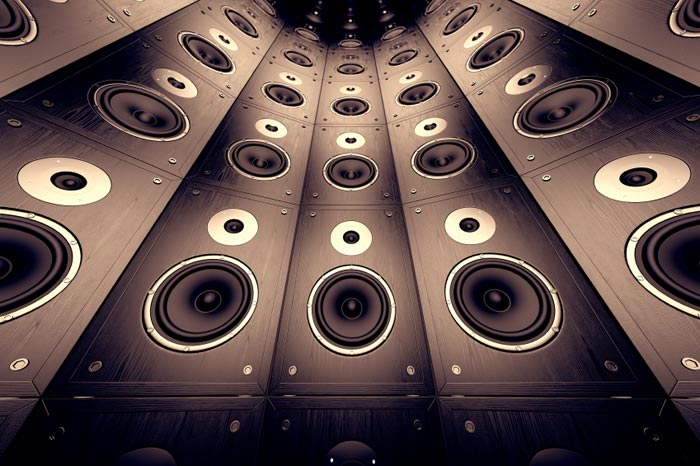
Illustration of a wall of speakers

Wall of sound — a perforated wall transformed into an acoustic transmitter. (Courtesy: iStockphoto.com/3dmentat)

Sound hits a solid wall, and bounces back. That's just physics, right? Well, not anymore. A team of researchers has figured out how to turn a rigid wall into something almost entirely transparent to sound — creating what could be called an acoustically invisible wall.

Inspired by Light

The idea was inspired by a discovery in optics. Back in 1998, Thomas Ebbesen found that light could pass through a metal sheet pierced with tiny, subwavelength holes far more efficiently than anyone expected. This phenomenon, known as extraordinary optical transmission (EOT), revolutionized the field of photonics.

Physicists Sam Lee (Yonsei University, Seoul) and Oliver Wright (Hokkaido University, Japan) asked a simple question: could the same trick work for sound?

The Kitchen Cling Film Breakthrough

The team drilled tiny, regularly spaced holes into a rigid wall and covered them with a thin elastic membrane — essentially kitchen cling film. By carefully tuning the tension in the film to match the resonant frequency of incoming sound waves, they minimized the inertia of the air inside the holes, allowing sound to pass through almost perfectly.

This works as an acoustic analogue to the "epsilon-near-zero" (ENZ) materials in optics, where the effective refractive index of a channel approaches zero, making the wavelength inside it extremely long and allowing almost frictionless transmission.

Why It Matters

An acoustically transparent wall sounds like a party planner's nightmare, but the potential applications are genuinely exciting:

  • Acoustic engineering: Designing rooms where sound travels or stops exactly where you want it.
  • Medical ultrasound: Improved transmission of sound waves through barriers in medical imaging devices.
  • Stealth technology: Materials that can hide submarines or other objects from sonar detection.

Source: Physics World

Tuesday, May 14, 2013

Interfering atoms could help in gravitational waves detection !!

An artist's impression of gravitational waves from two orbiting black holes.

Gravitational waves — the faint ripples in spacetime predicted by Einstein over a century ago — are notoriously difficult to detect. The detectors we use today rely on laser interferometry, and while they're extraordinarily precise, they come with a major limitation: laser noise. A team of scientists in California is now proposing a fundamentally different approach, one that swaps lasers for atoms and could sidestep this problem entirely.

The concept is based on atom interferometry — a technique that exploits the wave-like nature of atoms to make ultra-sensitive measurements. In this proposed detector, two clouds of atoms would be separated in space and exposed to the same laser pulses. Because gravitational waves stretch and compress space differently at each location, the atoms at either end would experience a slightly different push from the laser. That difference, tiny as it is, would show up as a phase shift in the atom interference pattern — a direct signal of the passing wave.

Why Atoms Instead of Lasers?

The clever twist is that both atom clouds are illuminated by the same laser beam traveling between them. Because the laser noise affects both clouds identically, it cancels out in the final measurement. The gravitational wave signal, however, doesn't cancel — it remains. This makes the detector inherently immune to laser phase noise, a major source of error in conventional gravitational-wave observatories like LIGO.

The team, which includes physicists Steven Chu and Mark Kasevich, believes this design would be not only more noise-resistant but also potentially cheaper and more practical to deploy in space compared to laser-based alternatives like LISA (the Laser Interferometer Space Antenna). Space-based detectors are desirable because they can reach the very low frequencies that ground-based instruments can't access due to seismic noise.

Still Early Days, But Promising

This is still a theoretical proposal, and turning it into a working detector would require enormous engineering effort. The atom clouds would need to be separated by vast distances — possibly thousands of kilometers — and the precision required is almost mind-bending. But atom interferometry has been advancing rapidly in recent years, and the fundamental physics checks out.

If this approach can be realized, it could open a new observational window on the universe — one sensitive to gravitational waves at frequencies that current detectors simply cannot reach. From merging supermassive black holes to the early universe itself, the science that could follow is genuinely exciting.


Source: Physics World

Cold-atom random laser simulates stellar clouds

Random lasers are a peculiar breed — they produce coherent light not through a conventional mirrored cavity, but through multiple scattering inside a disordered medium. It's essentially light bouncing chaotically until enough of it amplifies and exits. The phenomenon was first spotted in astrophysical clouds decades ago, but recreating it in a controlled laboratory environment has been a long-standing challenge. Now, a team of physicists in France has done it — using a cloud of cold atoms.

The researchers cooled rubidium atoms to extremely low temperatures, forming a diffuse atomic cloud that acts simultaneously as the scattering medium and the gain medium. When they shone laser light into this cloud, photons scattered repeatedly between atoms. Some of those atoms, excited by the incoming light, emitted additional photons through stimulated emission — amplifying the signal. The random, multiple-scattering paths through the cloud essentially replaced the need for mirrors.

A Lasing Effect Without a Laser Cavity

What makes this result particularly interesting is how cleanly the team was able to observe and characterize the random lasing threshold — the point at which scattering and amplification combine to produce coherent light output. Cold atoms offer precise control over temperature and density, which allowed the researchers to tune the behavior of the system far more carefully than is possible with solid-state random lasers or hot atomic gases.

This level of control also means the experiment is a beautiful analog for what happens in stellar environments. In dense astrophysical clouds, starlight undergoes similar repeated scattering and amplification, and astronomers have long suspected that random lasing contributes to some of the bright emission features observed. A laboratory system that mimics this physics could help astrophysicists understand those processes in much greater depth.

More Than Just a Lab Curiosity

Beyond the astrophysical parallels, cold-atom random lasers open up new avenues in quantum optics. Because the atoms can be manipulated at the quantum level, researchers can probe the boundaries between classical and quantum light scattering in ways that aren't possible with other random laser systems. It's a rare case where one experiment speaks meaningfully to both cutting-edge fundamental physics and the distant fires of stellar clouds.


Source: Physics World