EnglishFrenchGermanSpainItalianDutchRussianPortugueseJapaneseKoreanArabicChinese Simplified
If you like the site do not forget to Subscribe to our mailing list

Enter your E-mail address:

Wednesday, December 30, 2015

Protein Acceleration Become Easy !

Proteins are the workhorses of all living things. They carry oxygen in your blood, fight infections, digest food, and power your muscles. Nature builds them through evolution — a process that takes millions of years. But what if we could speed that up to just a few hours?

That's exactly what engineers at Stanford University have done. They've developed a new technique to dramatically accelerate protein evolution in the lab, opening up a shortcut to designing better drugs, industrial enzymes, and more.

Stanford Engineering Protein Research

How Normal Protein Engineering Works

Traditional directed evolution — the standard lab technique for improving proteins — works by randomly mutating a protein's genetic sequence, testing the results, keeping the best performers, and repeating the cycle. It works, but it's slow. Each round can take weeks, and the search space of possible mutations is astronomically large.

What Stanford Did Differently

The Stanford team developed a light-based screening system that can evaluate huge numbers of protein variants simultaneously and very rapidly. Using a photonic detection system developed by collaborator Thomas Baer from the Stanford Photonics Research Center, the researchers can identify promising protein candidates in hours or days instead of weeks.

What Can This Be Used For?

  • Better cancer drugs: Designing antibodies that target tumors more precisely.
  • Industrial enzymes: More efficient enzymes for making biofuels or breaking down plastics.
  • Food science: Engineering proteins with improved nutritional or functional properties.

Protein engineering used to be like finding a needle in a haystack. This new method essentially turns on the lights and gives you a magnet.


Source: Stanford News

Tuesday, February 17, 2015

serious skin infections Resolved!!!!

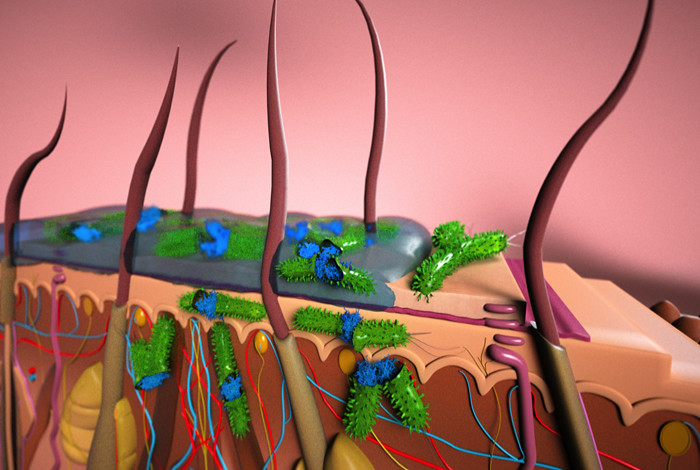
Ionic liquid treating skin infection
Artist's rendition of an ionic liquid penetrating skin layers to combat a bacterial biofilm infection. Credit: Los Alamos National Laboratory

One of the most stubborn challenges in modern medicine is treating infections that hide behind a biofilm — a slimy, protective shield that bacteria build around themselves. These bacterial fortresses are responsible for around 80% of all bacterial infections in humans, and they can be 50 to 1,000 times more resistant to antibiotics than regular bacteria. Scientists have been struggling with this problem for decades. Now, researchers from Los Alamos National Laboratory may have found a way through.

A "Magic Bullet" From Chemistry

The breakthrough came from an unexpected source: ionic liquids — salts that remain in liquid form at room temperature. Researchers discovered that certain ionic liquids can penetrate the outer layer of biofilms and disrupt the protective matrix, making the bacteria inside far more vulnerable to treatment.

What's particularly impressive is that in lab tests, these ionic liquids proved more effective than standard bleach at destroying biofilms — a striking result, since bleach is typically a go-to for disinfection. The ionic liquid didn't just weaken the biofilm; in many cases it completely neutralized the pathogens inside.

Military and Medical Applications

This discovery could be especially valuable for military medicine, where wound infections are a major challenge. Biofilms often grow around the edges of a wound, hiding under intact, healthy skin where normal antibiotics and topical treatments can't reach. The ionic liquid can penetrate the outer skin barrier (the stratum corneum) to get to where the infection actually lives.

Future research will focus on making these compounds safe and effective enough for clinical use. If successful, they could become a new standard of care for stubborn skin infections that currently have very few treatment options.


Source: Los Alamos National Laboratory

Monday, February 16, 2015

New way of cooling large objects with light!!!

Lasers are famous for heating things up. But a team of physicists in Germany and Russia has flipped the script, using laser light to cool a large, macroscopic object — and they did it by turning a major problem (noise) into a solution.

Michelson-Sagnac interferometer schematic for cooling
Schematic of the Michelson-Sagnac interferometer used in the cooling experiment. Laser light enters from the left, is split into two beams traveling a triangular path, and cools the mirror in the middle. (Credit: Andreas Sawadsky and Roman Schnabel/Leibniz University of Hannover)

How Do You Cool Something With Light?

Physicists have been cooling tiny mirrors with lasers for years. Here's how it works: when a mirror vibrates (because it has thermal energy), a laser beam reflecting off it picks up a slight frequency shift. By carefully tuning the laser, the light can carry away that vibrational energy, effectively slowing the mirror's motion and cooling it down. This is called optomechanical cooling.

Until now, the technique only worked on tiny, microscopic mirrors. The challenge with large mirrors is that random thermal vibrations (“noise”) from the environment constantly kick the mirror, overwhelming the cooling effect. The new technique uses a special Michelson-Sagnac interferometer that converts that random noise into a useful signal — and then uses it as part of the cooling mechanism rather than fighting against it.

Combining both dispersive and dissipative coupling in a Michelson-Sagnac interferometer, the researchers successfully cooled a macroscopic mirror far beyond what was previously possible.

Why It Matters

  • Gravitational-wave detectors: Cooler mirrors mean less noise and higher sensitivity in detectors like LIGO.
  • Quantum mechanics at human scales: Large quantum oscillators could help test whether quantum rules apply to everyday-sized objects.
  • Quantum computers: New components made from cooled mechanical systems could advance quantum computing.

Source: Physics World

Sunday, February 15, 2015

20 Things .. Know About Nuclear Accidents

Nuclear accident aftermath

Credit: Anatoli Kliashchuk/Demotix/Corbis

Nuclear accidents leave a long shadow. The disasters at Chernobyl in 1986 and Fukushima Daiichi in 2011 are the most prominent examples, and the scientific record of their effects on the environment, wildlife, and human health is both vast and deeply sobering. Here are some of the most striking things researchers have documented about what happens when a nuclear power plant fails.

Chernobyl: Still Leaving Its Mark

  • The Chernobyl disaster is expected to leave measurable radioactive contamination across a 15,000-square-mile area for approximately 300 years.
  • In the immediate aftermath, pine tree needles in a 1.5-square-mile zone around the plant turned red from radiation exposure. The trees that grow there now are stunted and lack normal central stems.
  • Scientists studying barn swallows near Chernobyl between 1991 and 2006 found 11 distinct types of physical abnormalities, including malformed beaks and deformed feathers.
  • The brains of 48 bird species living around Chernobyl have been measured at around 5 percent smaller than average. The suspected cause is radiation-induced oxidative stress during development.
  • Rodent populations near the plant show genetic damage that has accumulated over generations, with some lineages carrying mutations that would not be seen in unaffected populations.
  • Despite the ongoing radiation, the Chernobyl Exclusion Zone has paradoxically become a wildlife refuge in some respects, with large mammals like wolves, lynx, and wild boar thriving in the absence of human activity.

Fukushima: Ongoing Biological Effects

  • Researchers measured elevated and less spatially variable radiation levels around the Fukushima Daiichi plant following the 2011 meltdown, complicating efforts to model exposure zones.
  • Within six months of the Fukushima meltdown, 28 percent of pale grass blue butterflies collected in the region showed physical deformities, including abnormal wing patterns, malformed antennae, and deformed legs.
  • Follow-up studies found that the proportion of deformed butterflies increased in later generations, suggesting the mutations were being inherited.
  • Some marine species near the Fukushima coast showed elevated cesium-137 levels for years after the initial release, complicating fishery safety assessments.

What We've Learned

  • Low-dose radiation effects are notoriously difficult to quantify, and the scientific community continues to debate the precise risks at the levels experienced outside the immediate exclusion zones.
  • Both accidents highlighted how quickly radioactive materials can disperse through water, soil, and food chains in ways that were not fully anticipated.
  • Emergency preparedness, reactor design, and regulatory frameworks have all been significantly revised following these events, though experts continue to debate whether current standards are adequate.
  • The psychological and social effects of nuclear accidents — displacement, anxiety, and economic disruption — are now recognized as significant components of the overall harm, sometimes exceeding the direct health effects of radiation exposure.

Understanding nuclear accidents is not just about managing radiation. It's about the long-term interplay between technology, environment, and the communities that live in their shadow.


Source: Discover Magazine