


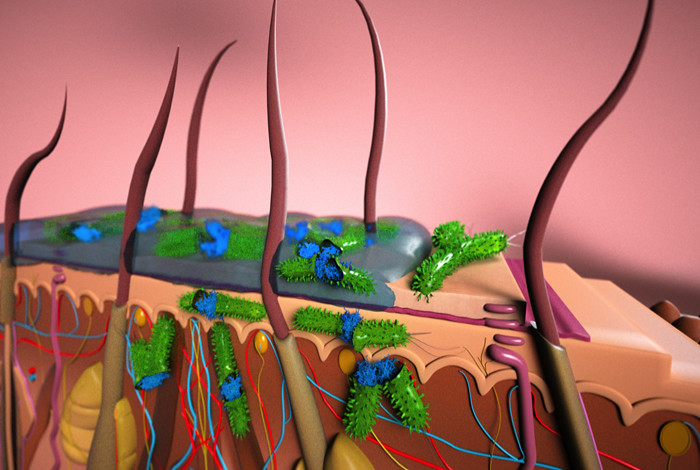
Artist's rendition of an ionic liquid penetrating skin layers to combat a bacterial biofilm infection. Credit: Los Alamos National Laboratory
One of the most stubborn challenges in modern medicine is treating infections that hide behind a biofilm — a slimy, protective shield that bacteria build around themselves. These bacterial fortresses are responsible for around 80% of all bacterial infections in humans, and they can be 50 to 1,000 times more resistant to antibiotics than regular bacteria. Scientists have been struggling with this problem for decades. Now, researchers from Los Alamos National Laboratory may have found a way through.
A "Magic Bullet" From Chemistry
The breakthrough came from an unexpected source: ionic liquids — salts that remain in liquid form at room temperature. Researchers discovered that certain ionic liquids can penetrate the outer layer of biofilms and disrupt the protective matrix, making the bacteria inside far more vulnerable to treatment.
What's particularly impressive is that in lab tests, these ionic liquids proved more effective than standard bleach at destroying biofilms — a striking result, since bleach is typically a go-to for disinfection. The ionic liquid didn't just weaken the biofilm; in many cases it completely neutralized the pathogens inside.
Military and Medical Applications
This discovery could be especially valuable for military medicine, where wound infections are a major challenge. Biofilms often grow around the edges of a wound, hiding under intact, healthy skin where normal antibiotics and topical treatments can't reach. The ionic liquid can penetrate the outer skin barrier (the stratum corneum) to get to where the infection actually lives.
Future research will focus on making these compounds safe and effective enough for clinical use. If successful, they could become a new standard of care for stubborn skin infections that currently have very few treatment options.
Source: Los Alamos National Laboratory


0 comments:
Post a Comment