EnglishFrenchGermanSpainItalianDutchRussianPortugueseJapaneseKoreanArabicChinese Simplified
If you like the site do not forget to Subscribe to our mailing list

Enter your E-mail address:

Showing posts with label Los Alamos. Show all posts

Tuesday, February 17, 2015

serious skin infections Resolved!!!!

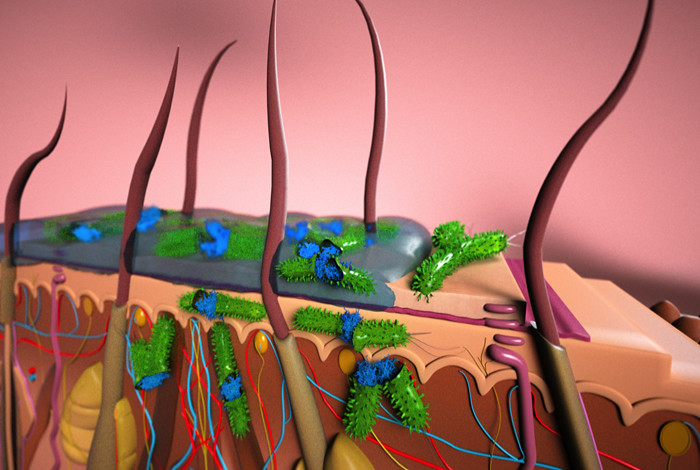
Ionic liquid treating skin infection
Artist's rendition of an ionic liquid penetrating skin layers to combat a bacterial biofilm infection. Credit: Los Alamos National Laboratory

One of the most stubborn challenges in modern medicine is treating infections that hide behind a biofilm — a slimy, protective shield that bacteria build around themselves. These bacterial fortresses are responsible for around 80% of all bacterial infections in humans, and they can be 50 to 1,000 times more resistant to antibiotics than regular bacteria. Scientists have been struggling with this problem for decades. Now, researchers from Los Alamos National Laboratory may have found a way through.

A "Magic Bullet" From Chemistry

The breakthrough came from an unexpected source: ionic liquids — salts that remain in liquid form at room temperature. Researchers discovered that certain ionic liquids can penetrate the outer layer of biofilms and disrupt the protective matrix, making the bacteria inside far more vulnerable to treatment.

What's particularly impressive is that in lab tests, these ionic liquids proved more effective than standard bleach at destroying biofilms — a striking result, since bleach is typically a go-to for disinfection. The ionic liquid didn't just weaken the biofilm; in many cases it completely neutralized the pathogens inside.

Military and Medical Applications

This discovery could be especially valuable for military medicine, where wound infections are a major challenge. Biofilms often grow around the edges of a wound, hiding under intact, healthy skin where normal antibiotics and topical treatments can't reach. The ionic liquid can penetrate the outer skin barrier (the stratum corneum) to get to where the infection actually lives.

Future research will focus on making these compounds safe and effective enough for clinical use. If successful, they could become a new standard of care for stubborn skin infections that currently have very few treatment options.


Source: Los Alamos National Laboratory

Tuesday, February 19, 2013

New process speeds conversion of biomass to fuels!

Furan ring opening process for biomass to fuel conversion

Opening furan rings into linear chains is a critical step in making usable fuels from biomass. (Image: Josh Smith, Los Alamos National Laboratory)

Converting plant material into liquid fuel sounds like a clean, elegant solution to our energy problems — and in many ways it is. But the chemistry involved is far from simple. Biomass-derived molecules often contain structures called furan rings, and breaking these open is a necessary step before the material can be turned into the kinds of alkanes found in gasoline and diesel. Getting this reaction to happen efficiently, without burning through enormous amounts of energy in the process, has been a major research challenge. A team at Los Alamos National Laboratory has now made real progress on exactly that problem.

The researchers worked out the detailed mechanism behind the key conversion steps, and found that the reactions can be carried out under relatively mild, energy-efficient conditions. That's important because industrial-scale fuel production needs to be economically viable, and energy-intensive chemical processes eat into both the cost savings and the environmental benefits of going bio-based in the first place.

The Case for Non-Food Biomass

What makes this line of research particularly appealing is that it uses non-food plant material — crop residues, grasses, wood waste — rather than edible crops. This sidesteps one of the main criticisms of first-generation biofuels like corn ethanol, which compete directly with food production. If biomass conversion can be made efficient at scale, it could provide a genuinely carbon-neutral liquid fuel, since the CO² released during combustion is balanced by the CO² the plants absorbed while growing.

There's also a strategic dimension. Many countries spend vast sums importing petroleum; a domestic biomass-to-fuel industry could reduce that dependency significantly. But the economics only work if the chemistry is clean, cheap, and scalable — which is exactly what understanding the reaction mechanism helps to achieve.

From Lab Insight to Industrial Process

Knowing how the furan-ring-opening reaction works at a mechanistic level gives chemists a foundation for designing better catalysts and optimizing reaction conditions. With the mechanism mapped out, engineers can begin building processes that bring biomass conversion from a laboratory curiosity to something that operates at the volumes needed to make a real dent in fuel supply. It's the kind of fundamental advance that doesn't make headlines on its own — but without it, the practical technology never gets built.


Source: Physics World